


The most important part of an emergency often happens before the patient ever reaches a hospital door.
A heart attack, a stroke, a serious crash: in each of these moments, the clock is already running; And the vehicle that arrives first can decide how the story ends. That is why ambulances are far more than a way to get from one place to another. Vehicles such as the Ford Transit Life Support Ambulance are designed to function as more than transportation. They enable the care to begin long before a patient reaches the emergency department.
Why Demand for Ambulances Is Growing
The biggest driver for the rising demand is a world that is growing older.
According to the World Health Organization (WHO), by 2030 one in six people in the world will be aged 60 or over, and the number of people in that age group will rise from 1 billion in 2020 to 1.4 billion. By 2050 it will double to 2.1 billion, and the number of people aged 80 or older is expected to triple to 426 million.
The shift is no longer confined to wealthy nations. WHO notes that low- and middle-income countries are now experiencing the greatest change, with two-thirds of the world’s population over 60 expected to live in them by 2050. Heart attacks, strokes and sepsis are among the emergencies WHO lists as everyday demands on first-contact care. As more people live into older age, the need for a fast, well-equipped emergency response only grows.
Ageing populations are only part of the story. Rising urbanization, increasing road traffic injuries, expanding healthcare access and growing investment in emergency medical services are also driving demand for modern ambulance fleets. As healthcare systems grow and patient transfer networks become more sophisticated, the need for reliable ambulance vehicles capable of supporting advanced pre-hospital care continues to increase.
Care That Can’t Wait
WHO states that many proven health interventions are time dependent. Emergency care exists to recognize and treat acute illness and injury quickly, whether that means a medical, surgical or obstetric emergency, an injury, sepsis, a heart attack or a stroke.
The numbers behind it are striking. WHO estimates that over half of deaths and over a third of disability in low- and middle-income countries could be addressed by effective emergencies and critical care. It also describes pre-hospital and facility-based emergency care as a high-impact and cost-effective form of secondary prevention.
This is where the ambulance earns its place. A properly equipped ambulance lets treatment begin immediately, at the roadside or at the patient’s home, rather than waiting until the patient reaches a hospital. Monitoring, oxygen, resuscitation support and skilled hands travel with the patient from the very first minute.
Meet the Ford Transit Life Support Ambulance
Designed with the demands of developing countries in mind, Ford Transit Life Support Ambulance focuses on durability, reliability and the lifesaving capability that health service providers need for every mission.

A Foundation You Can Trust
The ambulance is built on the versatile Ford Transit High Roof platform, powered by a 3.5L turbo diesel engine paired with a 10-speed automatic transmission and rear-wheel drive configuration. It combines proven commercial vehicle durability with the capability required for emergency medical operations.
Space Designed Around Patient and Staff
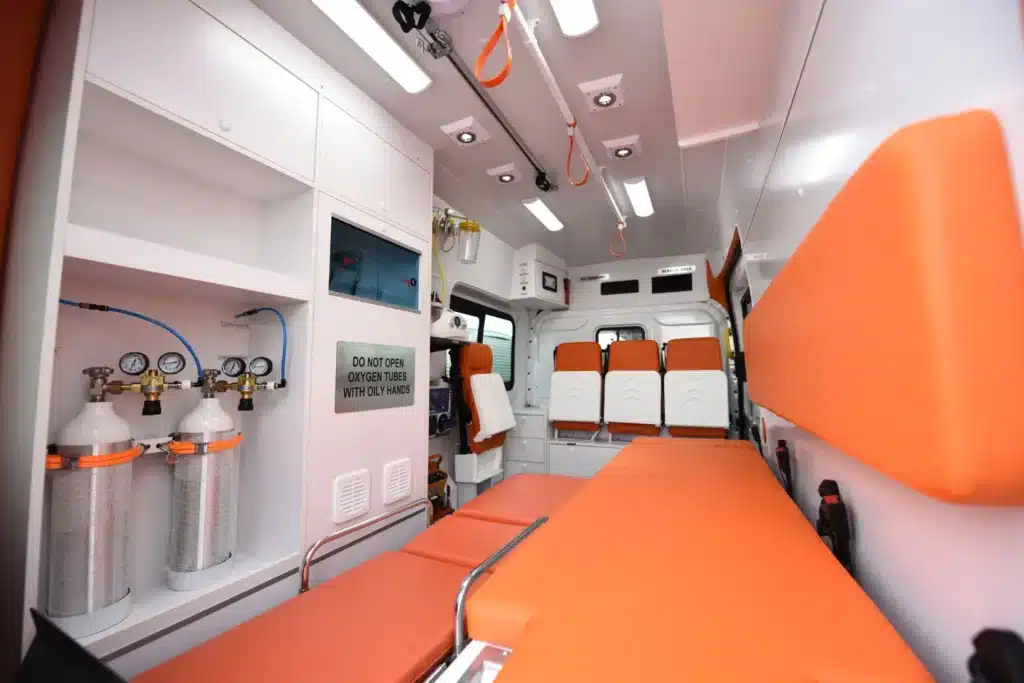
When the situation is critical, a cramped, awkward vehicle costs time. The Transit Ambulance is designed to prioritize ease of access, with:
- A high roof for working room inside the patient compartment
- Wide-opening rear swing doors for loading and unloading
- A side sliding door, with a sliding step, for convenient entry
- A stretcher and stretcher loading ramp to support patient loading
- Smooth hygienic fiberglass and aluminum interior surfaces that are easy to keep clean
- Ample LED lighting for clear visibility during care
- Multiple storage cabinets, including dedicated storage for oxygen equipment and medical devices
- Patient and crew-focused features such as grab handles, a foldable attendant seat and a bench seat with integrated storage and safety belts
- The result is efficient use of space, allowing crews to reach what they need quickly and focus on the patient rather than the vehicle.
Medical Equipment, Securely Integrated
The ambulance integrates lifesaving medical equipment from leading global suppliers. With more than two decades of experience developing ambulance solutions, Ford Global Fleet Sales specialists have designed dedicated mounting locations and storage systems to keep critical equipment secure, organized and easy to access while in transit.
Standard Ambulance Systems
The Ford Transit Life Support Ambulance comes equipped with:
- Dual oxygen cylinders with mounting brackets
- 2,000W electrical inverter system
- 220V AC power supply with power sockets
- 12V DC power supply with power sockets
- Digital touchscreen patient compartment control board
- Rear compartment air duct system
- Integrated air conditioning controls
- Ceiling extraction fan for ventilation
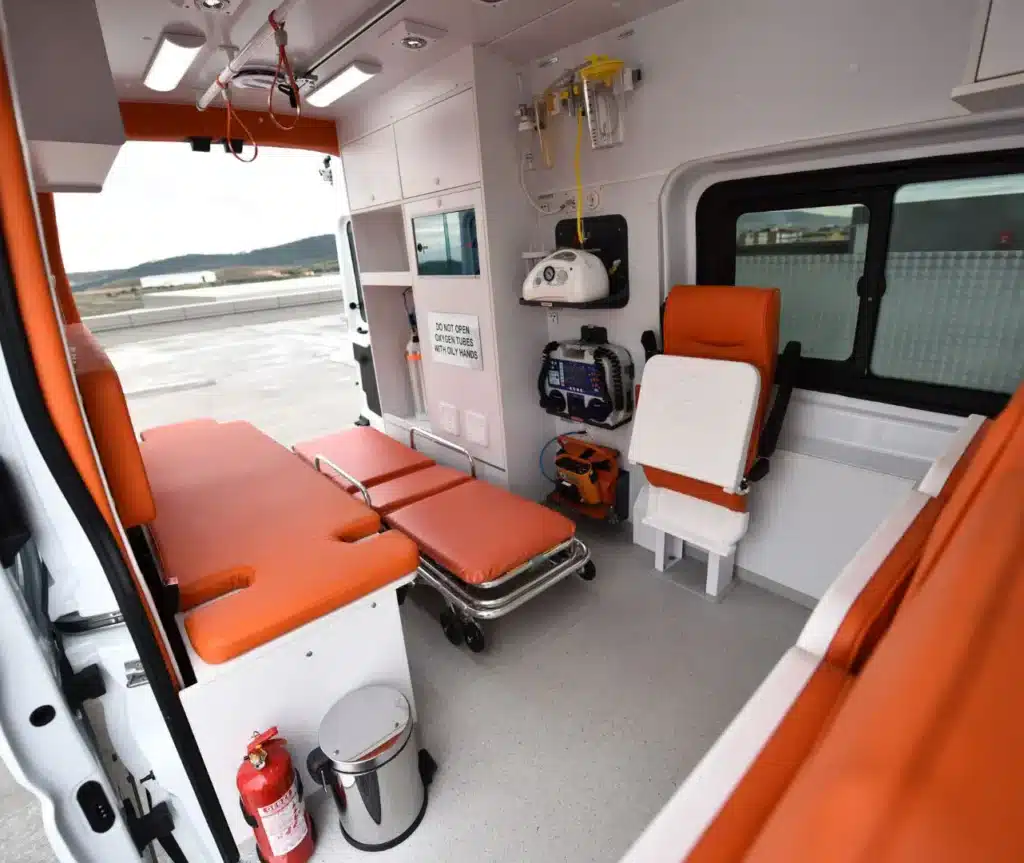
- Purpose-built storage cabinets for medical equipment and supplies
- Main stretcher with mounting base and loading ramp
Available Medical Equipment
Depending on operational requirements, the ambulance can be equipped with:
- Portable defibrillator
- Portable ventilator with assist control
- Electric suction aspirator
- Finger pulse oximeter
- Portable oxygen regulator kit and carry bag
- Resuscitation equipment
- Adult spine board
- Scoop stretcher
- Extrication collar
- Head immobilization equipment
- Pole stretcher
Each item is positioned securely and remains within easy reach, allowing staff to focus on patient care when every second counts.
Tailored to Your Service
Not every health service operates in the same way. The Transit Ambulance can be customized to individual requirements, allowing Ministries of Health, hospitals, NGOs and private operators to specify a vehicle that fits their own protocols, operational needs and budgets rather than settling for a one-size-fits-all solution.
Available options include negative pressure systems with HEPA filtration, EN1789 medical supply kits, front-rear intercom systems, reversing cameras, additional emergency lighting and enhanced oxygen storage solutions.
Global Support That Goes Beyond Delivery
An ambulance is only valuable when it is on the road. Ford Global Fleet Sales backs its vehicles with after-sales support that includes parts operations, service and technical support, training and logistics, helping fleets stay ready for the next call.
Ford Global Fleet Sales complements RMA SV’s engineering capabilities through global vehicle sourcing, export management, fleet delivery, technical training, and after-sales support across multiple markets. This integrated approach helps our customer reduce procurement complexity, accelerate deployment, and maximize the long-term value of fleet investments.
Ready to Equip Your Fleet?
Let’s Continue the Conversation. Request a quote, download the product sheet, or get in touch with our team to discuss the right ambulance solution for your service. Our team are ready to discuss operational requirements and future possibilities.
Sources: WHO Emergency Care; WHO Ageing and Health Fact Sheet; Ford Transit ERV Product Sheet.


